Everform Science / Cognitive function
Semax & Selank
Explained
Cognitive Function, Stress and the Evidence
Comparing brain signalling, anxiety-related findings and the evidence behind cognitive peptide claims.
 Conceptual illustration
Do Semax and Selank improve cognitive performance, or change how people feel under stress? The distinction matters more than the familiar “focus versus calm” shorthand.
Clearer thinking is not a single outcome
Semax is often presented as the peptide for drive, and Selank as the peptide for calm. That comparison is easy to remember. It also folds several different questions into one: does someone feel more alert, experience less anxiety, perform better on a memory test, or sustain better judgement under pressure?
Those outcomes can overlap in everyday life, but they are not interchangeable measurements. Feeling less distracted does not by itself demonstrate improved learning. A change on a brain scan does not establish better work performance. And an anxiety study cannot automatically answer whether a healthy person will become cognitively sharper.
Our central question is therefore more precise: what evidence supports the familiar “focus versus calm” comparison, and how far can that evidence take us?
Different research origins; an incomplete mechanism map
Semax is a synthetic seven-amino-acid peptide related to an ACTH fragment. In a rat hippocampus study, Dolotov and colleagues reported changes in BDNF and TrkB signalling, alongside a change in conditioned avoidance behaviour. This gives a biological reason to investigate learning-related effects. It does not show that a person reporting brain fog has a BDNF deficit that Semax will correct.
[1]Selank was developed as a synthetic analogue of tuftsin. Volkova and colleagues studied neurotransmission-related gene expression in rat frontal cortex, comparing Selank with GABA. Their results supported further investigation of GABAergic involvement, rather than identifying a complete, clinically validated explanation of how Selank would affect every person.
[2]The distinction is useful: Semax has a neurotrophic-signalling research history, while Selank has been investigated in relation to anxiety and neurotransmission. The evidence does not reduce neatly to an accelerator for one compound and a brake for the other. Both descriptions are simplified interpretations, not reliable predictions of an individual response.
What has actually been measured in people?
A 2020 study examined resting-state functional connectivity in 52 healthy participants across Semax, Selank and placebo groups. The investigators reported shared and compound-specific changes involving connections between the right amygdala and right temporal cortex. This is relevant because it compares both peptides within one experimental setting.
[3]However, its outcome was brain connectivity. It was not a demonstration that one compound produces superior concentration at work, that the other improves public speaking, or that combining them creates a better cognitive result. A measurable neural response and a useful performance improvement are different endpoints.
Selank also has small clinical studies in people with anxiety-related diagnoses. A 2008 report compared 30 participants receiving Selank with 32 receiving medazepam, using symptom-rating scales. The abstract reported similar anxiety-related effects and also described activating effects with Selank. That finding is already more complicated than the label “the calming one”.
[4]A separate 2014 comparative study in 60 patients reported anxiety-related and mild nootropic effects against phenazepam. These are clinical populations and active-drug comparisons. The abstracts do not describe a placebo arm or provide enough methodological detail for a full assessment of blinding and bias. They offer a signal for investigation, rather than a settled answer about enhancement in healthy adults.
[5]The evidence at a glance
| Study setting | What was assessed | What it cannot establish |
|---|---|---|
| Semax · rats | Hippocampal BDNF/TrkB measures and avoidance behaviour. [1] | A diagnosis or treatment for human brain fog. |
| Selank · rats | Neurotransmission-related gene expression in frontal cortex. [2] | A predictable calming response or complete human mechanism. |
| Both peptides · 52 healthy participants | Resting-state functional connectivity. [3] | Durable improvement in everyday cognitive performance. |
| Selank · 62 and 60 patients | Anxiety-related clinical outcomes against active comparators. [4][5] | Broad cognitive enhancement in healthy people or equivalence to a research vial. |
This is a focused comparison of selected primary studies, not an exhaustive systematic review. For the human clinical reports, the assessment here is limited to the available English abstracts. Study populations, formulations and endpoints should remain attached to each finding.
Why “I feel sharper” still needs a second question
A report of less mental noise can be meaningful to the person describing it. The next question is what changed: anxiety, motivation, sleep, expectations, task difficulty or measurable performance?
The source account describes a cloud lifting with Semax and less physical tension around public speaking with Selank. These are personal or coaching observations. They can help identify questions worth studying, but they are not controlled comparisons and cannot tell us how often a response occurs.
The same applies to the idea that these compounds only help when there is a “gap” to close. It is an appealing explanation for different experiences. The selected studies did not validate a rule that the more foggy or stressed a person feels, the more likely either peptide is to help. Nor do they show that feeling nothing means someone was already functioning perfectly.
A useful cognitive trial would specify the task, compare performance with an appropriate control, account for practice effects and assess whether a difference lasts. Without that structure, a convincing explanation can run ahead of the result it is meant to explain.
Different from caffeine does not mean risk-free
The scientific question is not resolved by calling a compound “non-stimulant” or “non-sedating”. Those descriptions do not establish how it will affect an individual, and they do not replace an assessment of adverse effects, interactions or longer-term exposure.
The studies discussed here do not establish the safety of a Semax–Selank combination, or compatibility with antidepressants and other medicines affecting the nervous system. A morning-and-evening pairing is not validated simply because the compounds are assigned complementary roles online.
Likewise, a simple age cut-off or a list of symptoms cannot turn a research discussion into a screening tool. Questions involving anxiety, neurological history or existing medication need an appropriately qualified healthcare professional. This article provides no dosing, administration or combination instructions.
The important limit is practical: an absence of a reported problem in a small study does not establish that a problem cannot occur in a different person, formulation or setting.
Product quality is a separate question from benefit
Identity, content and stability matter when interpreting any experiment. But a report that someone felt nothing cannot establish that a product was counterfeit, weak or degraded. Those are analytical questions requiring appropriate testing, not conclusions that follow from a subjective response.
Equally, documentation confirming a material’s identity or measured content does not prove cognitive benefit, clinical suitability or safety for personal use. A research vial is not automatically equivalent to the formulation used in a human study, and its labelled amount is product content rather than a recommended dose.
When checking Everform documentation, the full REF on the product should match the relevant documentation. If a security sticker is present, it repeats that identifier and should match the vial or pen; it is not a separate new ID.
What can we reasonably conclude?
Semax and Selank have distinct research histories, but “more drive” and “more calm” are not established, universal outcomes. Mechanistic work supports further investigation. Small human imaging studies show biological responses. Selank’s clinical reports raise questions about anxiety-related effects in specific patient groups. None of those findings should be silently converted into a general promise of sharper thinking.
For Everform Pharma in Da Nang, Vietnam, the useful comparison is therefore between questions and evidence: signalling, symptoms and performance. Keeping those separate helps readers understand why a compelling personal account and a scientifically established benefit can be different things.
The answer to our opening question is not that the compounds are identical, or that every reported experience is meaningless. It is that the evidence reviewed here does not justify choosing between them through a simple “focus versus calm” rule.
Common questions
Does increased BDNF mean better memory?
No such conclusion follows automatically. The cited Semax study measured rat hippocampal signalling and behaviour. It did not establish a human memory-enhancement claim.
Does less anxiety mean improved cognition?
Anxiety symptoms and cognitive performance are different outcomes. A study must measure the relevant endpoint before claiming an improvement in it.
Do the studies support using Semax and Selank together?
The 52-participant comparison studied separate groups. It does not establish the effectiveness or safety of a combined regimen.
Are the catalogue vials the same as the clinical study products?
Equivalence has not been established here. The Everform listings are laboratory research products, not instructions or authorisation for personal use.
References
- Dolotov OV et al. Semax and hippocampal BDNF/TrkB signalling in rats. Brain Research (2006).
- Volkova A et al. Selank Administration Affects the Expression of Some Genes Involved in GABAergic Neurotransmission. Frontiers in Pharmacology (2016).
- Panikratova Ya R et al. Functional Connectomic Approach to Studying Selank and Semax Effects. Doklady Biological Sciences (2020).
- Zozulia AA et al. Selank in generalised anxiety disorder and neurasthenia: clinical and biological findings. 2008. Russian article; English abstract.
- Selank and phenazepam: a comparative study of anxiolytic effects and tolerability. 2014. Russian article; English abstract.
This focused overview does not establish a diagnosis, clinical benefit, safety profile or suitable personal regimen. It is not medical advice. The conceptual hero image is not a scientific diagram. Everform products are for laboratory research only, not for human or veterinary use.
EXPLORE THE CATALOGUE
Featured in this article
Explore the individual Everform Pharma product pages mentioned in this article.
The 10 mg amounts are labelled vial contents, not recommended doses. These are laboratory research products, not verified equivalents of the formulations used in clinical studies.
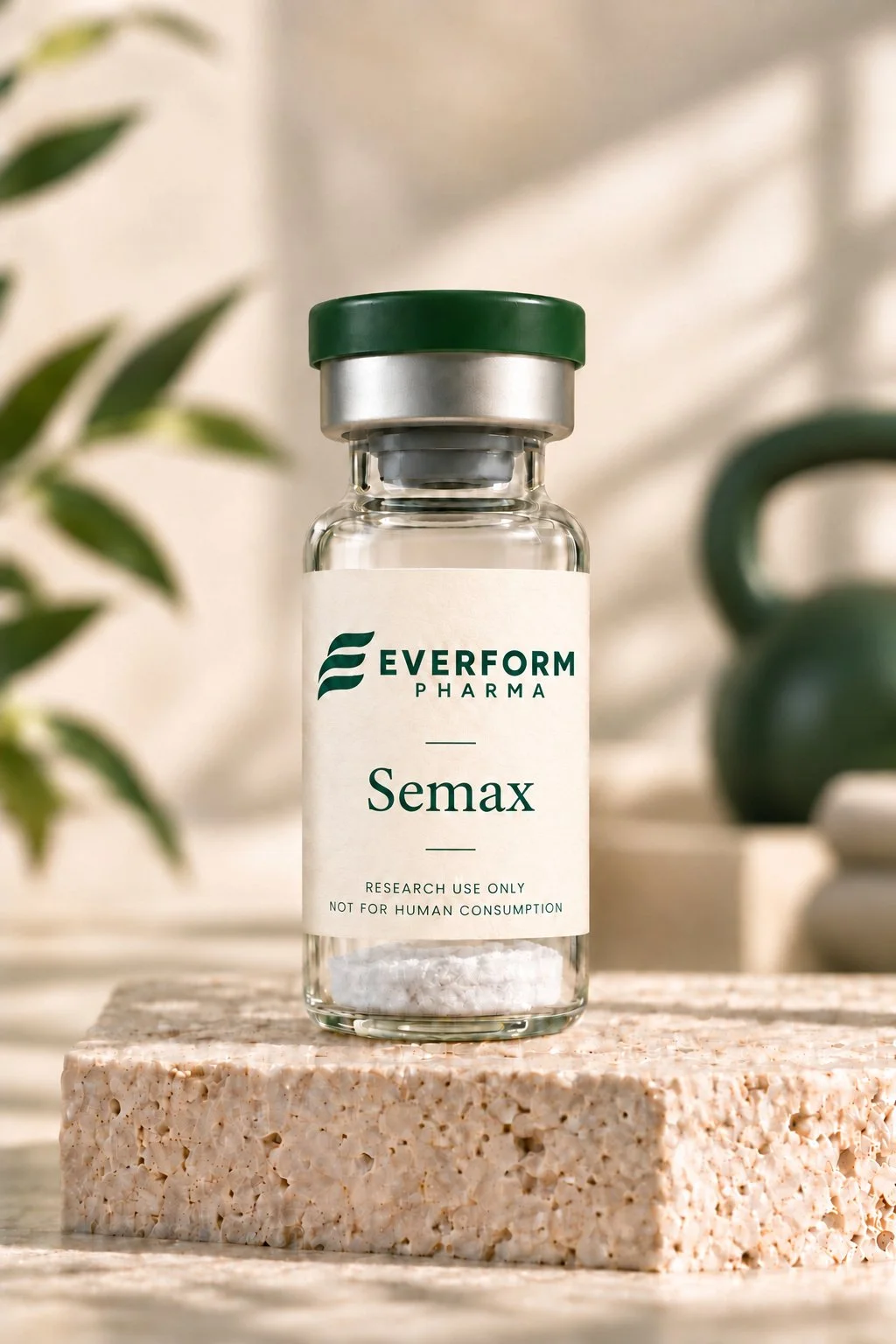
01 / Cognitive research
Semax · 10 mg
Discussed here in relation to neurotrophic signalling and human imaging research. These findings do not establish cognitive benefit or clinical equivalence for this laboratory research vial.
Explore Semax · 10 mg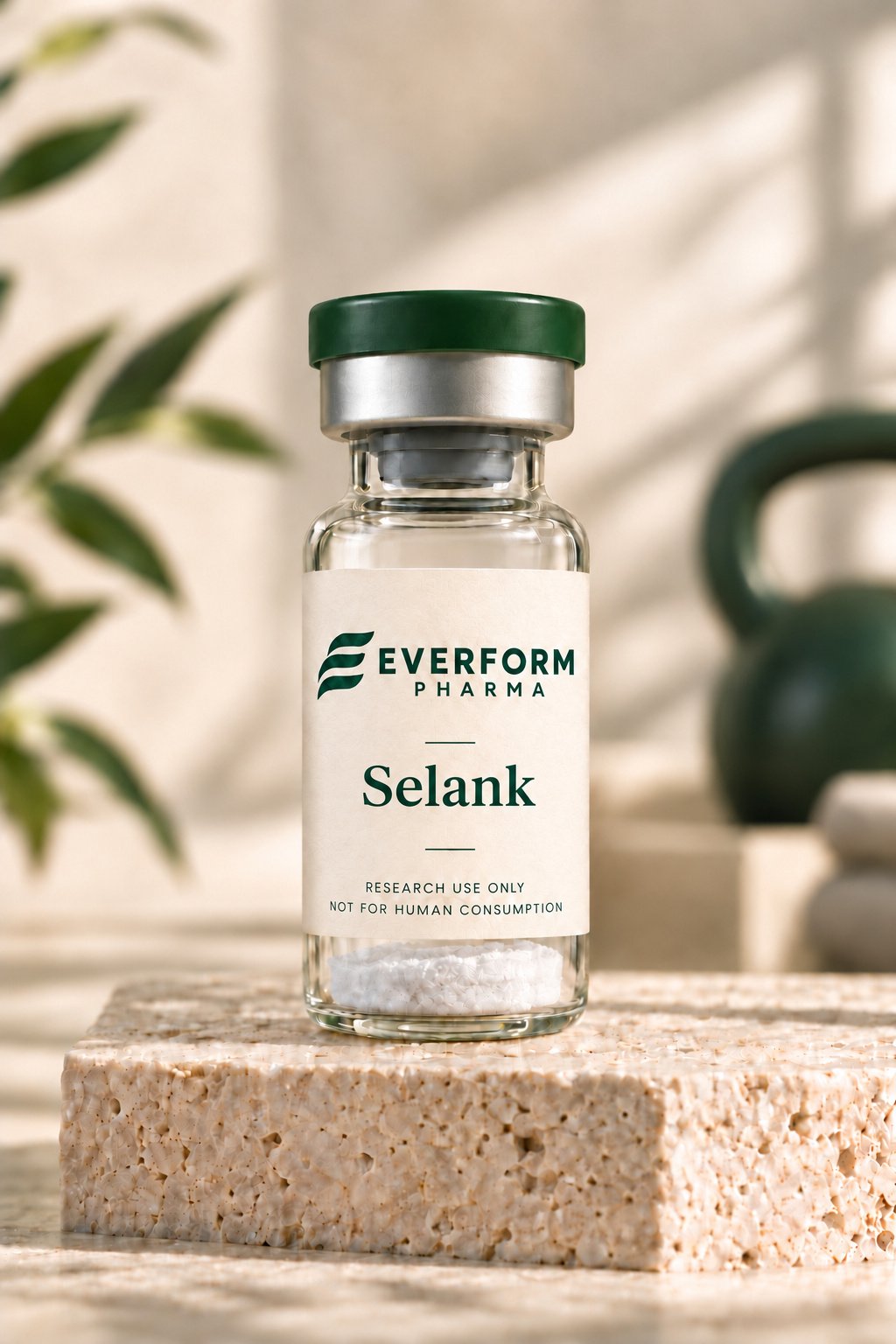
02 / Cognitive research
Selank · 10 mg
Discussed here in relation to anxiety-related studies and neurotransmission research. This listing does not establish symptom relief, cognitive enhancement or safe use with Semax.
Explore Selank · 10 mgFor laboratory research only. Not for human or veterinary use. Listing products does not establish the safety or effectiveness of their combined use.