Muscle & recovery research
Muscle Growth & Recovery
Explore the pathways researchers study in growth hormone signalling, body composition and tissue repair.

The science
What researchers measure

Hormone signalling
How receptors and the pituitary regulate growth hormone release.

Body composition
How studies distinguish changes in lean mass from changes in fat mass.

Tissue maintenance
How experimental models track tissue turnover and responses to injury.

Recovery outcomes
Which measurements can show how tissue responds after physical stress.
Compounds in focus
Growth hormone signalling
Compare four compounds by their research focus and receptor pathway.

Ghrelin receptor
Ipamorelin
A tool for studying the timing and selectivity of growth hormone release.
Read research overview
Early animal studies investigated how its hormonal response compares with other secretagogues. Those findings do not establish gains in muscle mass or recovery in humans.

GHRH signalling
CJC-1295 without DAC
A research analogue commonly referred to as modified GRF (1–29).
Read research overview
Researchers use it to explore short-duration signalling through the growth hormone-releasing hormone pathway. Confirm molecular identity in the product documentation because the name can be used inconsistently.

GHRH signalling
Sermorelin
A 29-amino-acid fragment used to study pituitary responses to GHRH.
Read research overview
Its research role includes comparing hormone-release patterns across compounds. Hormone responses alone do not establish changes in strength or muscle mass.

GHRH and body composition
Tesamorelin
A GHRH analogue studied in relation to growth hormone, IGF-1 and body composition.
Read research overview
Studies in specific clinical populations and formulations cannot be assumed to apply to healthy athletes or laboratory research materials.

Tissue response research
BPC-157
Studied in preclinical models of tissue injury. This research examines how tissues respond under controlled conditions.
Read research overview
The findings are predominantly preclinical. They do not establish that BPC-157 improves human healing, muscle growth or recovery.
Understanding the evidence
Measure the outcome that matters
A change in hormone levels is a different result from a change in muscle mass, strength or recovery. Read each study in the context of the formulation, population and outcomes it actually measured.
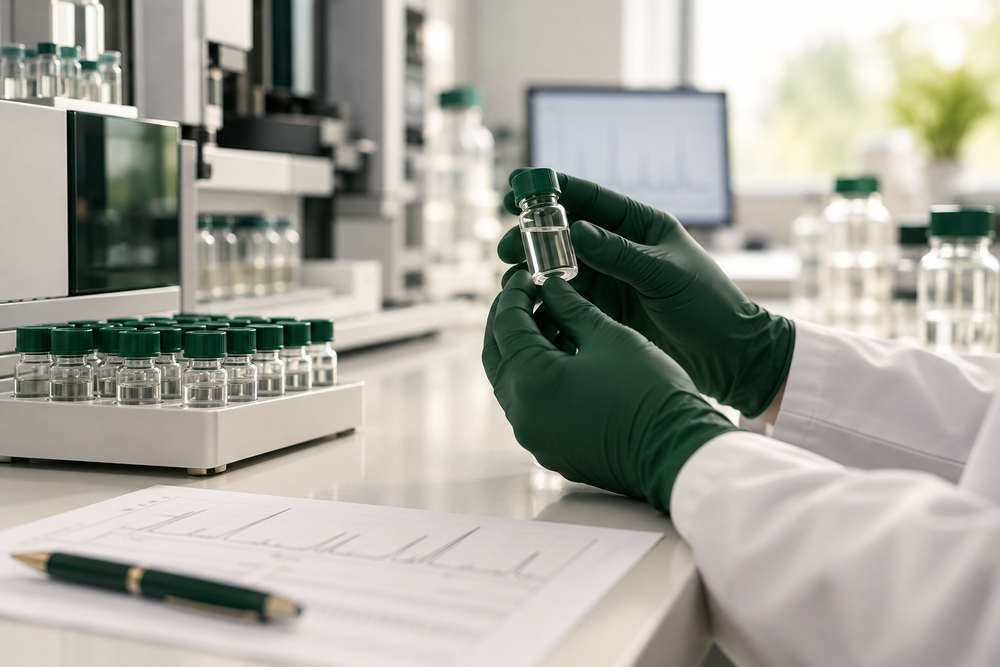
Quality documentation
Know the material
Review molecular identity, batch details, storage requirements and available Certificates of Analysis.
Common questions
Research FAQs
How do the compounds differ?
Ipamorelin is discussed in relation to the ghrelin receptor. CJC-1295 without DAC, Sermorelin and Tesamorelin are grouped by GHRH signalling. BPC-157 is presented separately because its research focus is tissue response.
Does growth hormone release demonstrate muscle growth?
A hormonal response alone cannot establish muscle gain, strength or recovery. Those outcomes need direct measurement.
What does “without DAC” mean?
DAC stands for Drug Affinity Complex. Check the product documentation for the precise molecular identity and distinguish it from the DAC form.
Why are Ipamorelin and GHRH-related peptides discussed together?
The different receptor pathways give researchers a reason to investigate their interaction. A biological rationale alone cannot establish whether combining them improves outcomes or is safe.
What can a Certificate of Analysis tell me?
It describes the tests performed on the sample. Clinical safety, compatibility and suitability for administration require different evidence.