Science & Insights / Tesamorelin
Tesamorelin and Visceral Fat
What does the research show?
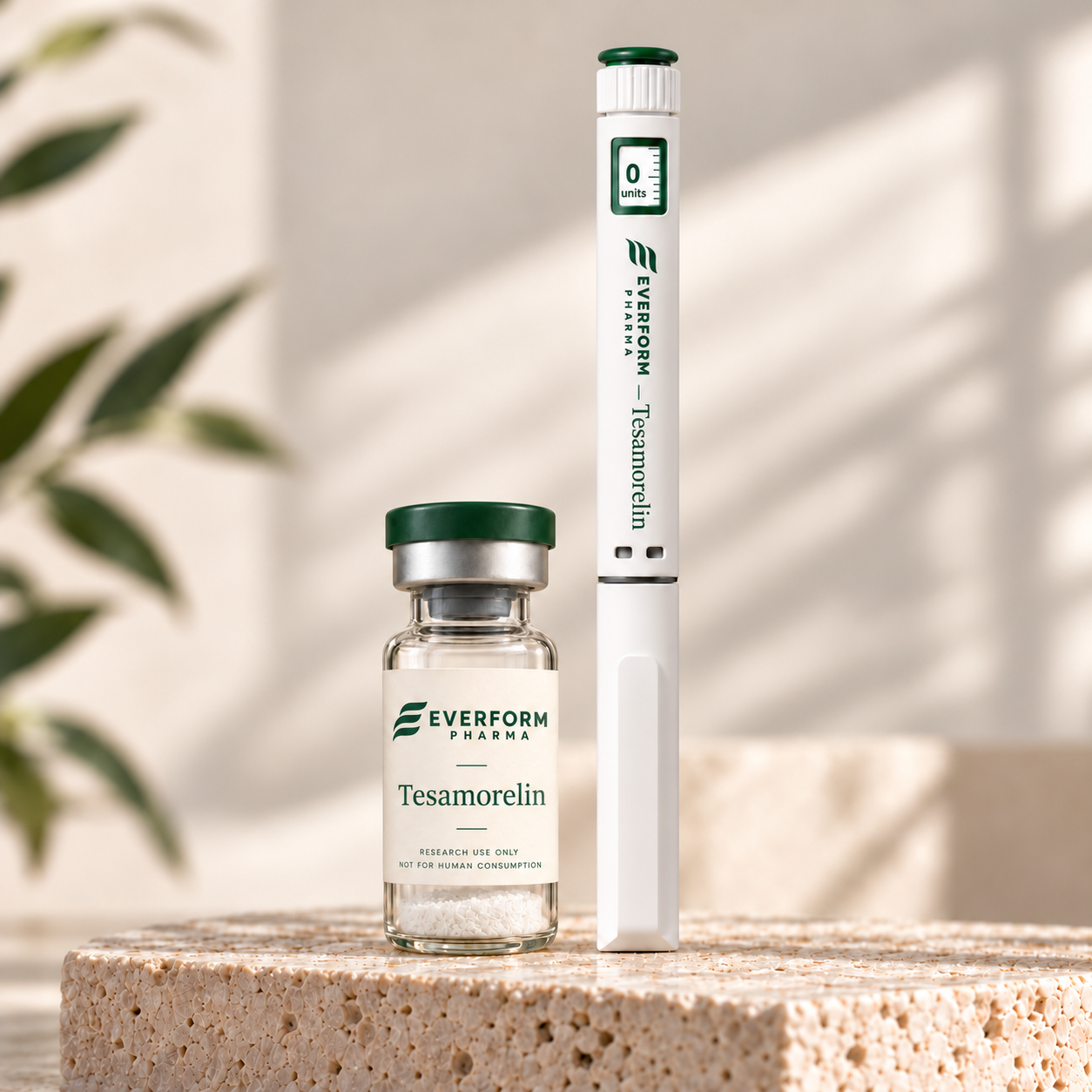
Discussions about abdominal fat often focus on appearance. The research behind tesamorelin asks a more specific question: can stimulating the body’s growth hormone pathway reduce the fat stored deep within the abdomen?
Tesamorelin has attracted attention across peptide research, metabolic health and healthy ageing. Understanding that interest means looking closely at who has been studied, what researchers measured and where the evidence stops.
At Everform Pharma, we believe those details belong at the centre of the discussion.
What is tesamorelin?
Tesamorelin is a synthetic analogue of growth hormone-releasing hormone, or GHRH. It stimulates the pituitary gland to release growth hormone and increases circulating insulin-like growth factor 1, commonly called IGF-1. It therefore acts upstream of growth hormone rather than supplying growth hormone directly. [1]
This mechanism explains its research interest, but it also explains why its effects require careful assessment. Stimulating the body’s own hormone production can still produce clinically significant adverse effects.
Why researchers focus on visceral fat
The pivotal tesamorelin studies focused on visceral adipose tissue: fat within the abdomen, around internal organs. This differs from subcutaneous fat beneath the skin.
The distinction matters when interpreting results. A measured reduction in visceral fat is not the same as losing an equivalent percentage of total body fat, and it does not predict a particular change in appearance.
What did the clinical trials find?
A pivotal study published in the New England Journal of Medicine enrolled 412 people with HIV and excess abdominal fat. Participants received tesamorelin or placebo for 26 weeks, with visceral fat assessed using CT imaging. [2]
| Measure | Tesamorelin group | Placebo group |
|---|---|---|
| Change in visceral adipose tissue | 15.2% reduction | 5.0% increase |
| Change in triglycerides | Decrease of 50 mg/dL | Increase of 9 mg/dL |
| Change in IGF-1 | 81% increase | 5% decrease |
These findings support an effect on visceral fat in the population studied. They do not establish the same response in healthy adults seeking cosmetic fat loss. The study population was also predominantly male, which matters when considering how widely the findings apply. [2]

Is tesamorelin a weight-loss treatment?
In the United States, prescription tesamorelin is approved to reduce excess abdominal fat in adults with HIV-associated lipodystrophy. The prescribing information explicitly states that it is not indicated for weight-loss management and describes its effect as weight neutral. [1]
For readers comparing peptide research, this is an essential distinction: an intervention can change a particular fat compartment without producing substantial overall weight loss.
What about liver fat?
Tesamorelin has also been investigated in people with HIV and fatty liver disease.
A 12-month randomised trial enrolled 61 participants. Compared with placebo, tesamorelin produced a treatment effect of approximately 4.1 percentage points on hepatic fat fraction, corresponding to a 37% relative reduction. At the end of treatment, 35% of the tesamorelin group had liver fat below 5%, compared with 4% of the placebo group. [3]
These results are promising, but liver fat and visceral fat are different measurements. A reduction in one should not be presented as an interchangeable measure of the other.
The investigators also called for further research into longer-term effects on liver histology. This study does not establish tesamorelin as a general treatment for fatty liver disease in people without HIV. [3]
Cognitive ageing: an exploratory research area
Interest in tesamorelin extends beyond body composition. A placebo-controlled study enrolled 152 adults aged 55–87, including people with mild cognitive impairment and cognitively healthy participants. Treatment lasted 20 weeks. [4]
Researchers reported benefits on executive-function measures. These findings justify further investigation, but they do not establish dementia prevention, reversal of cognitive ageing or a general benefit for memory. A favourable result on cognitive tests is a narrower finding than those broader claims. [4]
Side effects and important limitations
The prescription label identifies injection-site reactions, joint and muscle discomfort, fluid retention and possible carpal tunnel symptoms. It also warns about elevated IGF-1, glucose intolerance and diabetes. Active malignancy, pregnancy and disruption of the hypothalamic-pituitary axis are contraindications. [1]
The glucose figures deserve particular care: the label reports development of HbA1c at or above 6.5% in 5% of treated participants versus 1% receiving placebo, with a reported risk estimate of 3.3. That figure is a ratio, not “3.3%”. Glucose and IGF-1 monitoring form part of clinical care. Long-term cardiovascular safety has not been established. [1]
Weekly preparation does not mean weekly injections
The Egrifta WR formulation allows a reconstituted vial to provide seven daily doses. Its administration remains daily. Describing it simply as a weekly treatment would therefore be misleading. These instructions apply to that licensed formulation. [1]
How Everform Pharma reads the evidence
Our view is that useful peptide education should make the strength and boundaries of the evidence equally visible.
For tesamorelin, the strongest clinical case concerns excess abdominal fat in adults with HIV-associated lipodystrophy. Liver-fat and cognitive studies add research interest, while leaving substantial questions about broader applications.
When reading a peptide claim, ask three things: who was studied, what was measured and whether the conclusion matches the result. Those questions make the science more useful—and the marketing easier to assess.
Educational content only. This article does not recommend self-administration or provide a treatment protocol. Research-use materials should not be assumed equivalent to licensed prescription medicines.
References
1. Egrifta WR: US prescribing information.
2. Metabolic effects of a growth hormone-releasing factor in patients with HIV. New England Journal of Medicine, 2007.
3. Effects of tesamorelin on non-alcoholic fatty liver disease in HIV: a randomised, double-blind, multicentre trial. Lancet HIV, 2019.
4. Effects of growth hormone–releasing hormone on cognitive function in adults with mild cognitive impairment and healthy older adults. Archives of Neurology, 2012.